The Valley Has A Tell-Tale Heart Problem

When I watch The Valley, all I can think about is Edgar Allen Poe’s short story “The Tell-Tale Heart.” The motifs are all there: a house tense with secrets, an unreliable narrator, a crime readers are told is not a crime. Poe’s story begins with a plea: “True! - nervous - very very dreadfully nervous I had been and am; but why will you say that I am mad?” Recollecting events which have already transpired, the narrator is clear about his reasons for doing so: he wants the reader (an apparition) to affirm choices and actions that we soon learn are neither sane nor reasonable.
As he tells it, the narrator’s desire to murder the old man with whom he lived emerged from nowhere and was motivated by nothing except, “I think...his eye! yes, it was this! He had the eye of a vulture - a pale blue eye, with a film over it.” It is as though the thought occurred to him mid-sentence. He insists he loves the old man but his hatred of the “Evil Eye” consumes him nonetheless. His loathing begets obsession but the diligence with which he plotted, stalked, beheaded and dismembered the old man, then buried his limbs beneath the floorboards of his bedroom, are all, according to him, evidence of his stalwart sanity. The murder would relieve him of the problem of the eye, you see, which soon becomes the problem of the old man’s heartbeat.
“Have I not told you that what you mistake for madness is but over acuteness of the sense?” he insists. He’s just sensitive. When the police arrive, summoned by a neighbor at the sound of the man’s dying scream, the narrator is so elated, so confident in his deception that he invites them to sit for tea atop his victim’s corpse. Then he hears it: a ringing in his ear.
It grows and grows and becomes more defined and as it grows, so does he. “I arose and argued about trifles, in a high key and with violent gesticulations; but the noise steadily increased.” Recognizing “the hellish tattoo of the heart,” he convinces himself the police can hear it too; that their absence of reaction is a trick of some sort. Overcome, he blurts out his confession and directs them to tear up the floorboards to uncover “his hideous heart.”
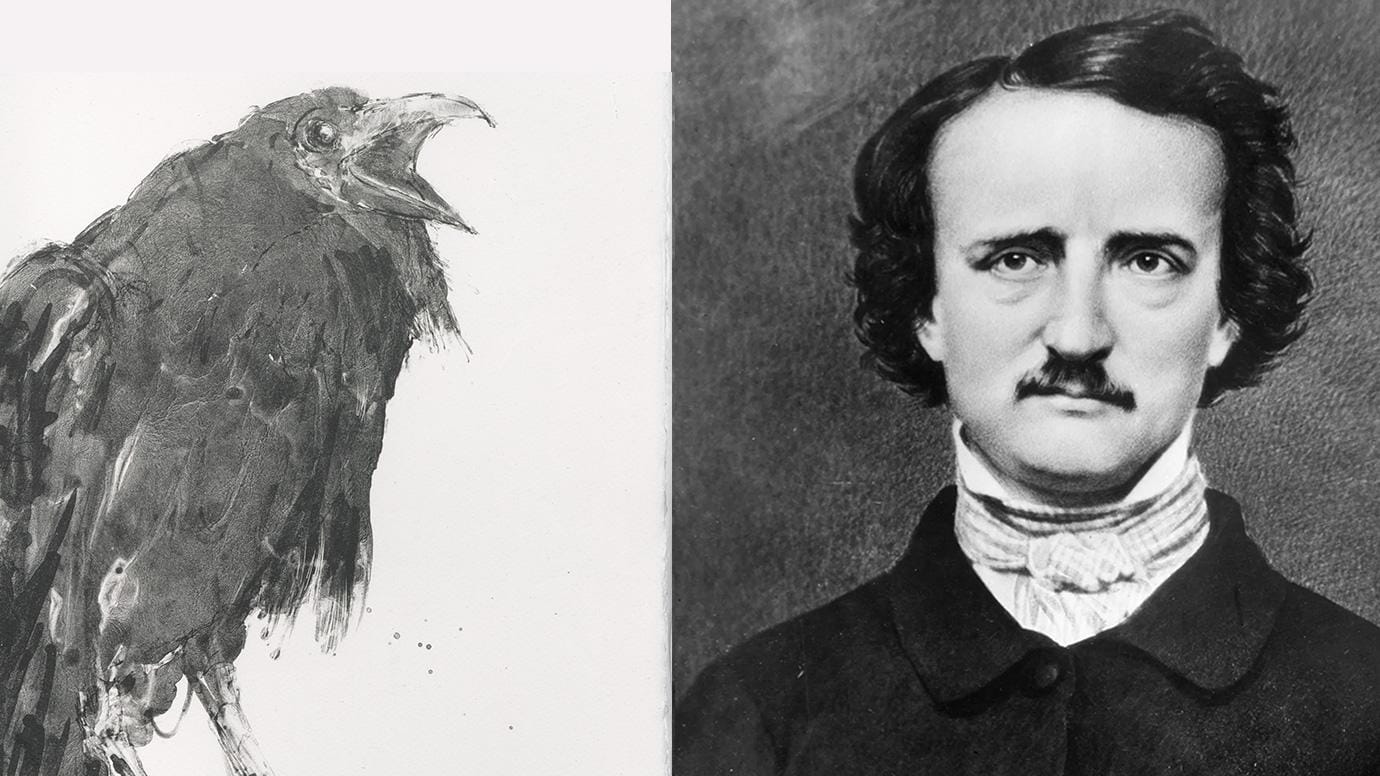
Edgar Allen Poe was born in 1809 and published “The Tell-Tale Heart” in 1843, about twenty years before the start of the American Civil War. The success of the Haitian Revolution at the turn of the century struck terror in the hearts of the colonial slave-owning powers, whose anxieties of insurrection manifested in their literature and thus became characteristic of the storytelling of the time. In Darkly: Black History and America’s Gothic Soul, Leila Taylor reflects on several of Poe’s stories, “The Tell-Tale Heart” included, all of which orient around “a similar theme: the attempt to get away with murder and the effort to deny it” (Taylor, Repeater Books, 50). The effort of this endeavor “haunts [Poe’s] protagonists,” drives them to madness and eventually destroys them. “In Poe’s America," Taylor attests, "they don’t get away with it." Instead, the guilt, the shame, the work of suppression leaks in unsuspecting ways, rotting the foundation of the figurative house.
Now, in 2026, that rot is exposed on reality tv as often (if not more) than in literary fiction. As a day one viewer of Vanderpump Rules, I knew The Valley was destined to be a work of American Gothic. Viewers follow the straggling remains of the VPR cast as they transition from bartending and dating/addiction problems in West Hollywood to playdates and mortgages in the San Fernando Valley. That’s how the show was sold at least. What it turned out to be is more like tax liens, post-partum depression, and romantic parasitism in Santa Clarita.
Indeed, every week is Bleak Week when The Valley airs, at least in part because it’s clear the show was cast to reproduce rather than depart from the gender/relationship dynamics seen on VPR which famously unfold as a consistent ritual sacrifice of the girls to the perpetuation of the boys’ story. Without fail, it’s the women whose limbs are always found hidden under the floorboards—regardless of whether the crime is committed by another woman.
Looming over The Valley’s modern farmhouses is the long shadow of Jax Taylor, who we watched for nine seasons of VPR move through the world like a dumb pulsating id: pure impulse, zero reflection, no recognizable humanity to speak of except that he wants. Vanderpump Rules’ first blockbuster scandal involved Jax cheating on then-girlfriend Stassi Schroeder with her best friend Kristen Doute, the then-girlfriend of Jax’s best friend Tom Sandoval (of Scandoval infamy). That was in 2013. In 2020, Stassi and Kristen were fired for filing false police reports against their sole Black castmate, Faith Stowers, as retribution after Jax cheated on his then-girlfriend/now-ex wife Brittany Cartwright with Faith. By the end of 2020, Jax and Brittany were also fired. An open lawsuit alleges that Lala Kent held a knife to Faith’s throat and that she was the subject of further racist abuse by additional cast members.
When the media phenomenon that was #Scandoval affirmed to the network that viewers didn’t altogether care that a woman’s life was endangered, the nascent spin-off became viable again and Kristen, Jax, and Brittany all returned to anchor The Valley. The first two seasons primarily showcased Jax’s continued, escalating abuse of Brittany (and cocaine), eventually culminating in Brittany filing for divorce on camera.
The third season was meant to be a hard reset, liberated as they purportedly were from the beast. But a key aspect of Jax’s MO—and production’s casting choices—has always been to surround him with men who were equally heinous if more adept at hiding it. Such men, in turn, flock to Jax as his company relieves them of the pressure to mask. With him, they don’t have to pretend to be loyal, considerate, “good” people. They’re free to be themselves.
Enter Danny Booko. Married to former Miss USA, Nia Sanchez, Danny and Nia were anointed with the title of series “aspirational” God-fearing church-going baby-having trad couple; a reputation mostly instilled by Kristen, her now-fiance/baby daddy Luke (a Midwest transplant who makes hating Los Angeles a personality) and fellow henchman Jesse Lally. For years, they extolled the virtues of Danny and Nia’s marriage, professing their admiration and desire to emulate them as seems to be a condition of their friendship. Then, between filming seasons one and two, Danny groped fellow cast member Jasmine Goode and her now-wife Melissa while he was wasted at a Halloween party.
For the purposes of this essay, I want to imagine the show as the old man’s house in Poe’s tale and the producers as its architects, authors, and ghostly subjects. One faction of the cast (Nia and Danny primarily) takes on the role of Poe’s narrator, and the other (Jasmine, most notably), the old man. Because this happened off-camera, actual material reality was transformed into the figurative space beneath the floorboards of the show/house where Danny and Nia have tried to bury this deeply ugly truth.
Even though the experience was hers to speak on, Jasmine was not the one to say the whole truth loudest. The severity of Danny’s “disrespectful” comments and behavior (personally, I’d use different adjectives, ones that include “lecherous,” “predatory,” “racist,” “sexist,” “homophobic” for starters) were obscured and obfuscated by conflating this particular occasion with his drinking overall. “Danny’s drinking” thus is coded language in the context of the show. Every conversation about his drinking is actually about him groping his coworkers, his general tendencies toward aggression, and the guaranteed likelihood of these incidents' recurrence.
More so even than Danny, Nia takes on the obsession of Poe’s narrator, insisting upon the wrongness of her husband’s actions while justifying, diminishing, and deflecting from the severity of them simultaneously. Far and away the most media-trained member of the cast, she doesn’t target Jasmine. Instead, kills her with kindness so to speak. The person Nia targets most directly is Janet Caperna, the one who calls Danny’s actions “sexual assault” on camera; who expressed feelings of discomfort in Danny’s presence which effectively Trojan horsed Jasmine’s experience onto the show. Janet is the eye whose gaze Nia claims drives her mad; whose words she considers more damaging than her husband’s actions.
In “The Tell-Tale Heart,” Poe uses sight and sound, the eye and the ringing in his narrator’s ears, the heart beating overloud to convey his narrator’s interior experience of guilt-laden paranoia. On The Valley, it’s the refrain of Nia and Danny’s complaints that he is “being labelled an alcoholic” as well as their compulsive and nonsensical finger-pointing at Janet, Brittany, Michelle, and even Jasmine herself that thumps repeatedly like a guilty conscience. Nia’s insistence that they “worked through it” in counseling rings hollow; the “work” they do as a couple seeming more akin to the work Poe’s narrator does to reason his way into committing an explicit unjustifiable wrong—the work required to bullshit and bamboozle oneself in service and protection of rotten urges.
Danny admitted what he did and apologized for it on camera. But his expectation is kind of as if the narrator expected the police to find the dismembered body and just walk away. Danny and his wife simply don’t think there should be any consequences for what he did, or that it’s some sort of injustice if people feel differently about him or them because of it. They’ve used Kristen, Luke, Jesse, and Zack like attack dogs, the four of them compulsively silencing Jasmine and vilifying Janet for Danny’s actions. And for a time, the audience—the eye, the police, per Gothic literary tradition—agreed with them.
Jasmine, Janet, and Jason were shredded on social media during season two, so much so that when the cast came back for season three, Nia, Danny, Kristen, Luke, and Zack were fat with the smug superiority of audience approval while Jasmine, Jason, and Janet groveled, offering undue apologies. The sainted couple succeeded. They got away with it. Except they didn’t. Not anymore than Poe’s narrator did. Not anymore than anyone who trespasses against another ever does. Shame is a haunting. The problem doesn’t go away when the problem is you.
Danny’s aggressive, condescending behavior, his incapacity to control or regulate himself, has been the drain the show has circled now for two whole seasons. It’s his “mistakes” that keep stinking up the figurative house, clogging drains and overflowing toilets. It would be generous to say Nia has become nose-blind. She perpetuates the problem by ignoring it, her limitless defense paid in the dignity of the women around her, Jasmine most specifically. It is she who has absorbed the full weight of what Danny did with minimal support, which includes the individual reactions or lack thereof of her friends and coworkers.
Indeed, there is a failure by both the cast, production, and the audience at large to imagine or consider Jasmine’s interiority as a human being. What is widely regarded as “flip-flopping” is what it looks like when a token Black person is forced to shrink and twist themselves into knots in order to navigate white people in conflict. This is what the white audience doesn’t understand and what the Black audience hates to see. Jasmine is constantly begging to be heard and respected by her friends/coworkers while also being given zero space to process or articulate her experience with someone who understands and can contribute to the conversation in a meaningful way. Zack can validate her experience of being gay, but no one’s there to validate or speak to her perspective as a Black woman who is constantly being thrown down the proverbial stairs so that her white “friends” can remain in good standing with the mean-browed gnome that molested her and her wife, for fear said gnome will come after them next.
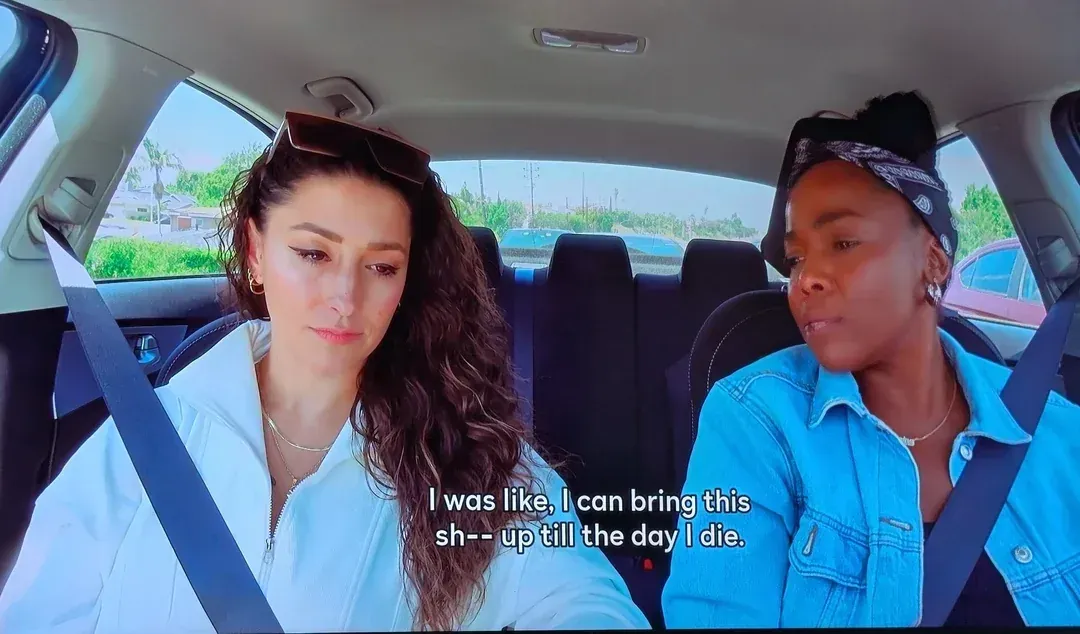
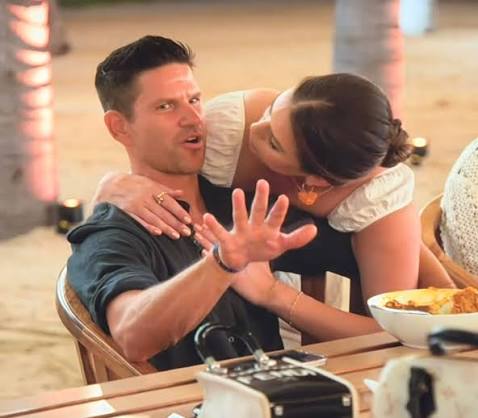
This is most evidenced by Jasmine’s relationships with Zack and Kristen, who she remains close with despite their vociferous defense of Danny and Nia. During a group conversation sparked by yet another of Danny’s drunken aggressions, Jasmine begins to share her perspective with Lala when Kristen, eyes locked on Nia, drapes herself across Jasmine’s lap and starts to giggle about how drunk Jasmine is, covering her body as though covering her mouth. It’s a moment of control disguised as affection that creates an opportunity for Nia to falsely equate Jasmine in this moment with Danny:
“The fact that they’re talking to me about Daniel having an issue with drinking when Jasmine’s over here like…,” she insinuates, then turns it around. “Is it okay if I talk about her?”
Danny grabbed intimate parts of Jasmine and Melissa’s bodies and made crude, vulgar, racially-charged insinuations to Jasmine. He happened to be drunk when he did this, but the problem was the groping and its associated entitlement. Drinking is the euphemism Nia uses to shield what he actually did, so that she can respond solely to her redaction as though it were the whole truth.
In the scene, Jasmine becomes visibly upset. “So, I shouldn’t talk right?” Jasmine declares while everyone ignores her. “There’s something that’s making me really upset that happened to me last year but she [Lala] can say it and nevermind.”
Lala, simultaneously, is sharing with Nia that she reacted to Danny from a place of having been hurt by men; that when she’s “triggered,” she “needs to talk about it.” This is what upsets Jasmine. Nia and Kristen listen, receive, and validate Lala’s vulnerability while burying hers. What happened to Jasmine is that she was violated and trespassed upon and her supposed “best friends” responded in defense of the person who did that to her.
Like Poe’s narrator, their claims (to love the old man, to love Jasmine) are in direct opposition to their actions. When Jasmine later confronts Kristen, she handles her using the most delicate kid gloves imaginable, managing Kristen’s ego the way Nia manages Danny’s. And Kristen validates her, apologizes in the moment when they’re one on one and was amply praised for doing so. But in front of Danny and Nia? Never. As with Faith, Kristen makes clear that she will not hesitate to sacrifice Jasmine if it means protecting Danny.
The same is true of Zack. What is arguably the season’s most explosive fight is ignited by Zack’s inexplicable defense of Danny after he promised Jasmine he’d do the exact opposite. Jasmine defends herself and her wife but is routinely shouted down and told to shut up for doing so while Danny is consoled for his PTSD. Eventually, she gives up. But still, her anger leaks.
If The Valley has become a case study in the dynamics of rape culture (and it has), it’s also necessarily a case study in the dynamics of interracial non-friendship. This is as true of Vanderpump Rules as it is of Summer House, Southern Charm, Southern Hospitality, Below Deck, and every Housewives franchise that has ever introduced a token non-white cast member just so their humanity can get hacked away and buried beneath the floorboards.
If the season finale–aptly titled “The Valley of the Damned”—reveals anything, it’s the impossibility of Danny and Nia’s return. They’re as desperate and deluded as Poe’s narrator and the cast, show, and audience all suffer for their presence. Indeed, The Valley is a microcosm of the interpersonal conflicts that underscore the large-scale systemic conflicts that have haunted America for the entirety of its existence. A white man thrust himself upon a Black woman and a Latin woman and demands his right to authorship and innocence as told in the Official Story. His bleating is like Poe’s narrator’s mania, “excited to fury” in his compulsion to drown out the sound of his guilt.
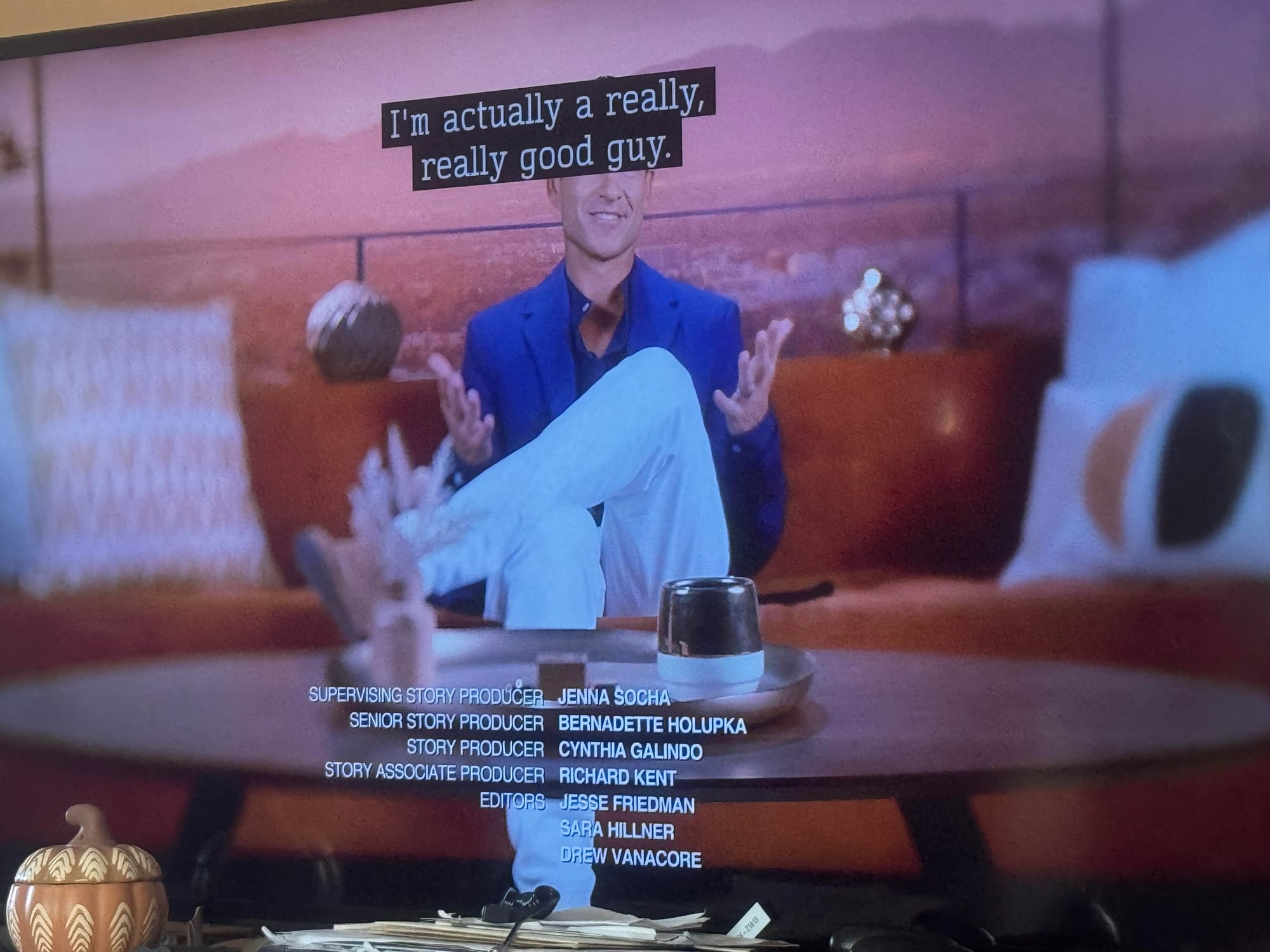
“Villains!” the narrator calls the police when he can’t stop himself from confessing. "I'm actually a really really good guy," Danny insists in his closing confessional. And in the end, whose “hideous heart” is truly revealed?